School’s starting soon, so our kids have started anticipating, wondering, and talking about what might come in fifth and third grade. The other night at dinner, soon-to-be-third-grade Daphne burst into tears with worry about high-stakes testing, timed tests for multiplication facts, and math textbooks. My paraphrase of what she said, approved by Daphne:
That’s not even math to me. I mean, getting answers fast without thinking isn’t even math. I like it when there’s a problem I have to work on and work on and work on, where I get parts wrong and I have to go back to it and figure out what I did, where it might take me hours, weeks, or even months to figure it out. That’s the kind of math I like!
The kids are always like, “Why did that test take you so long? I thought you were good in math?” Sometimes I’m the last one done and they all talk about it. But as soon as I know the test is timed, I can’t think very well, so it takes me longer. And I also take a long time because I like thinking about the problems, not just rushing to get the answers.
And I wonder, you know how they have DEAR–Drop Everything and Read? It’s a time where you don’t have to do worksheets or sticky notes or read something assigned. You can just read what you enjoy. Why don’t they have it for math? I wish we could Drop Everything and Math. Instead of worksheets or tests or problems, the kids could just look around and see what interests them. We could find a question of our own and ask it and work on figuring it out until we’re satisfied. That’s the kind of math I like, like what I did in Ghirardelli Square.
While she talked, I had a flood of conflicting feelings and questions. Of course, I was overjoyed to hear that Daphne still knows what mathematics is, regardless of her experience in school math thus far. She’s still intact, for now.
I was simultaneously crushed, listening to her expectations for math this year. Oof.
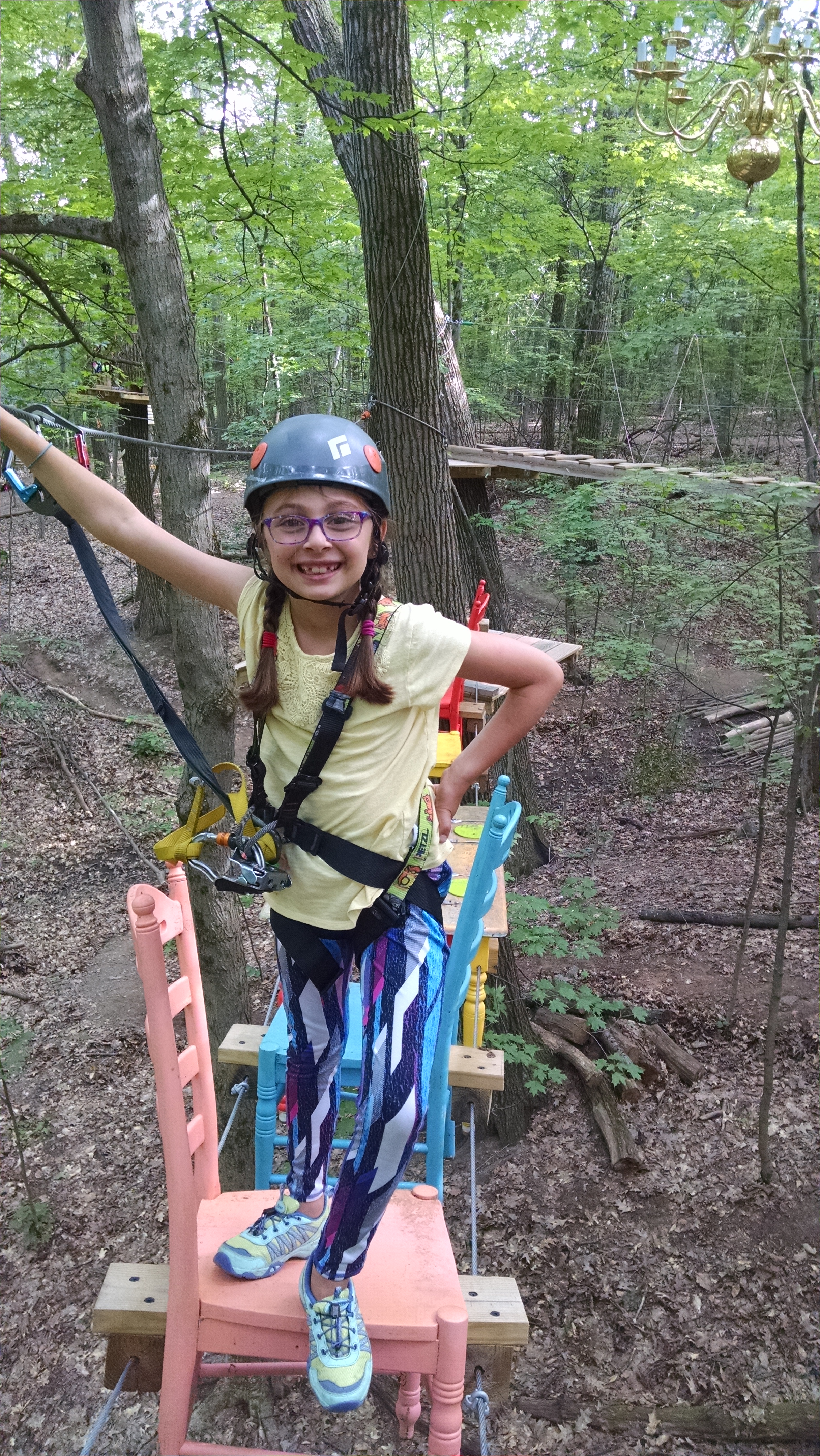
But then there was her love of working on a hard problem over time, of persevering and enjoying the grappling. Sam and I told her it’s a much more important life skill than giving quick answers to fact-recall questions. I mean, this is a kid who likes to face down a worthy challenge. Check her out after a hard part of this week’s ropes course in the Adirondacks.
I was also struck by this idea of Drop Everything and Math. Because, while it’s beautiful, we all know that if a teacher at any grade in a U.S. school told students it was time to Drop Everything and Math, that teacher would face a room full of blank stares. A classful of students waiting to be told what to do. Maybe even a group of students angry about the unclear expectations and absence of directions.
Based on their experience, students have concluded that teachers and textbooks ask the questions and students answer them. We tell students what to do at every juncture, right down to whether we want them to box or circle their answer, or fill in a bubble (completely! With no stray marks!).
If our students would be paralyzed by the suggestion to find a mathematical question of their own to explore, then that’s a call to action. We need to do something different. Students need to learn how to pose their own mathematical problems and questions, not just answer somebody else’s. And I’m talking about genuine mathematical questions, not just word-problem writing.
If you want some suggestions to get you started, I’ve gathered a whole bunch of resources around question-asking and problem-posing on the CH 7 page. A few hits, briefly:
- 101questions is a super resource. It’s a huge bank of curiosity-provoking images. Ask your kids “What questions come to mind?” They don’t need to answer the questions–just practice asking. If you can only spare five minutes now and then, you can still introduce question-asking via 101qs. (For a recent blogpost about one way to use 101questions and a bulletin board, take a peek at Mrs. Beauchemin’s “Are Our Students Really Thinking?“)
- Notice and Wonder. As Annie Fetter, Max Ray-Riek, and the rest of the gang at the Math Forum at NCTM have been teaching us, removing the question and asking students What do you notice? What do you wonder? opens tons of possibilities.
- Take a mathematical walk and see what math your students can spot around your school.
- Suggest students bring something mathy from home and have a gallery walk to discuss where they see math.
- If your school is equipped with the technology, you can host your own MathPhoto challenge. Ask students to look for lines, symmetry, curves, intervals, etc. Check the linked archives for more ideas.
- Invest in mathy playthings that spark conversation and delight. Christopher Danielson has you covered on materials, and Kassia Wedekind‘s ShadowCon talk will inspire you to make your math class more playful this year.
Daphne liked the acronym DREAM for Drop Everything and Math. Is hers a pipe dream? Or one that might see the light of day?
That’s up to you, I think.